
What scuba gear should you buy first?The order I would follow if I started again.
I started diving two years ago. I first completed my PADI Open Water certification and later my Advanced. I now have around 20 dives, mainly in Tenerife, in places such as Radazul, Tabaiba, El Porís, Abades and Los Cristianos.
I have bought my gear gradually. I did not buy a full setup at once because I do not dive often enough for every item to make financial sense, and storing, rinsing and drying bulky equipment while living in an apartment is not especially convenient.
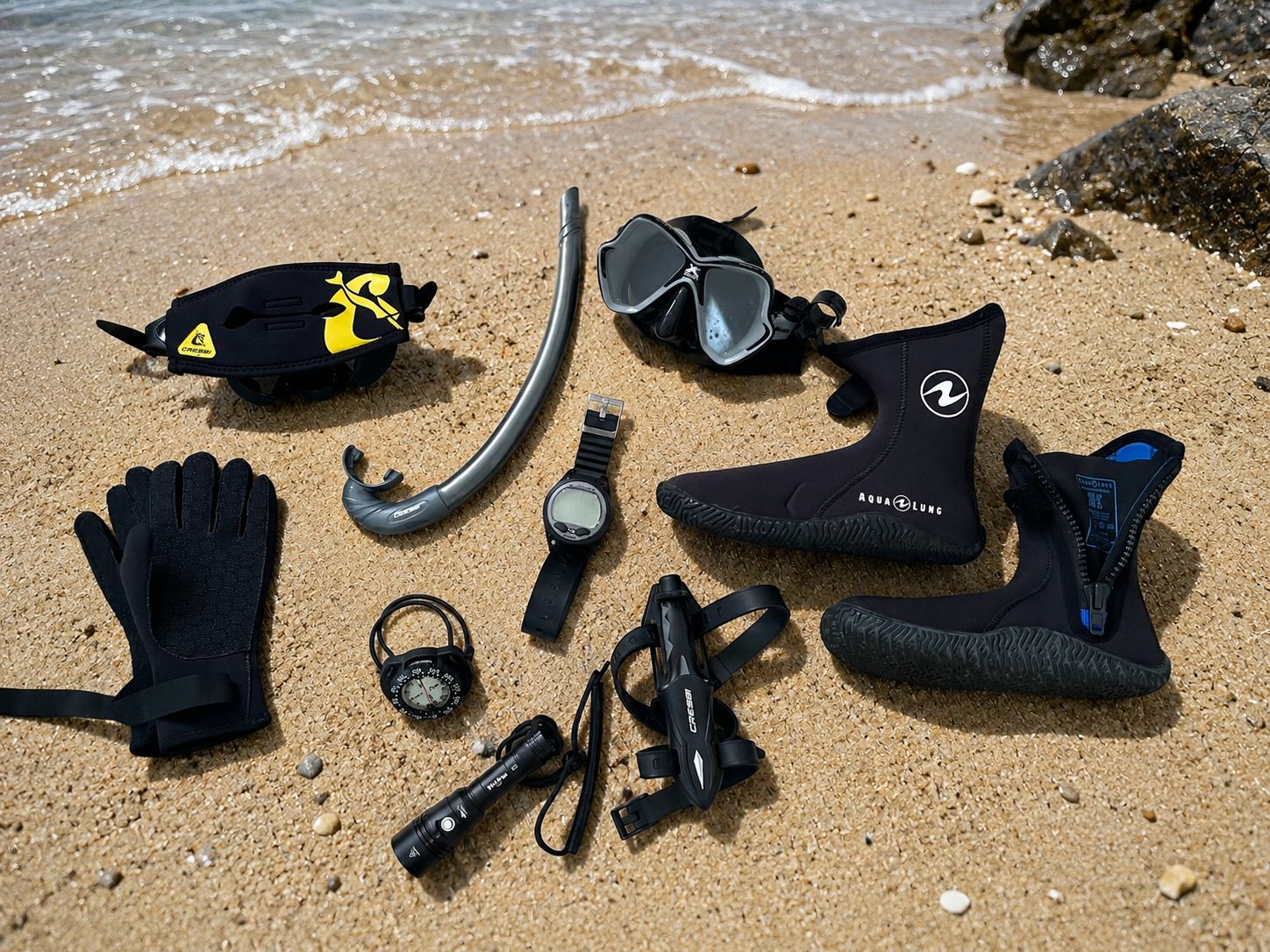
My quick answer: what would I buy first?
If I know I am going to keep diving fairly regularly, my first major purchase would be a dive computer. After that, I would prioritise a mask that fits properly and my own dive boots.
If my starting budget were smaller, I would begin with the items that bring the biggest improvement in comfort and hygiene: mask, snorkel and dive boots. The bulkier gear can be rented for quite a long time.
In what order would I buy scuba gear?
Dive computer
My first major purchase. Using the same computer every time helps you become familiar with its display, alerts, menus and the information you check underwater.
I chose the SCUBAPRO Aladin One Matrix, although I have also prepared a comparison with other beginner-friendly models.
Your own mask
Mask fit is very personal. A comfortable mask that does not leak and that you already know well can make a big difference to how relaxed you feel underwater.
Your own dive boots
They make sense for hygiene, comfort and because a good sole helps when you need to walk from the dive centre, car or dock to the water.
I use the Aqualung Echozip Ergo 7 mm, which I particularly value for warmth and the substantial sole.
Compass
A compass makes sense if you want to practise underwater navigation and learn one familiar model during courses and regular dives.
Marker light and dive torch
A marker light helps others see you. A primary torch is for illuminating the environment. Both become particularly useful once you start night diving.
Personal accessories
A flexible snorkel, mask strap cover, gloves and a compact safety cutting tool can be added later depending on the dives you actually start doing.
Still unsure which dive computer to choose?
My comparison covers the SCUBAPRO Aladin One Matrix alongside the Mares Puck 4, Cressi Leonardo 2.0, Cressi Donatello, Suunto Zoop Novo and Aqualung i300C.
Already preparing a dive trip or day out?
Once you know what is worth buying, the next step is checking what you actually need to bring: personal gear, documents, dry clothes and small accessories.
The order I actually bought my gear
My first purchases were the dive computer, mask and snorkel. The dive boots came next, along with a dive knife I received as a gift.
Later I added gloves and a wrist compass. Finally, I bought a marker light and a primary torch, especially with night diving in mind.
How much did each piece of my gear cost?
These are prices I paid or approximate figures gathered when preparing the guide. I have rounded them to make comparison easier.
Prices can change depending on retailer, seller, size, timing and promotions. They should not be treated as guaranteed current prices.
What to buy at different budgets
Comfort and fit
A logical combination if you want to start with personal, compact items you will use on almost every dive.
Hygiene and protection
This option prioritises personal equipment for hygiene and a few small comfort upgrades.
The main purchases
This would be my favourite starting point if you already know you want to keep diving.
A fairly complete personal kit
At this point you already have basic navigation, visibility and several personal accessories without moving into bulky equipment.
Expanded personal kit
At this budget I would also start considering a dedicated bag for wet dive gear.
Your own wetsuit or second-hand?
If you are diving more frequently, you can start considering your own wetsuit. A second-hand suit could also make sense if it is in good condition and, above all, fits properly.
I would not buy a wetsuit just because it is cheap. Fit, thickness, neoprene condition and the type of diving matter more than price alone.
What gear do I still rent, and why?
I still rent the wetsuit, fins, regulator, BCD, tank and weights.
The main reason is bulk. Living in an apartment makes it harder to store, rinse and dry all of that gear properly. If you do not dive very frequently, buying everything may not make financial sense either.
- Wetsuit: takes up space and the right thickness changes with conditions.
- Fins: bulky and still convenient to rent when you dive infrequently.
- Regulator: requires servicing and maintenance.
- BCD: bulky, and I would rather try different models first.
- Tank: involves storage, transport and maintenance.
- Weights: heavy and inconvenient to store and move from an apartment.
Mistakes I would avoid when buying my first scuba gear
- Buying dive boots too tight: check sizing carefully.
- Choosing gloves that are too thick: they can reduce dexterity.
- Assuming a bigger dive knife is better: for recreational diving I prefer something compact and accessible.
- Confusing a marker light with a primary torch: one makes you visible; the other illuminates.
- Buying bulky gear without storage space: the cost continues after purchase because gear also needs cleaning, drying and maintenance.
FAQ: what scuba gear should a beginner buy first?
What should I buy first with around €100?
I would prioritise compact personal gear: a mask and snorkel, or dive boots plus a few small accessories.
Is it worth buying a dive computer early?
For me, yes, if you already know you are going to keep diving. Using the same one every time helps you learn its displays and alerts.
What scuba gear can I keep renting?
Wetsuit, fins, regulator, BCD, tank and weights can all be rented for quite a long time.
What would I buy for hygiene?
Especially your own mask and dive boots: both are personal, easy to store and used on almost every dive.
Do beginners need to buy a full scuba setup?
No. I prefer to buy gear gradually, based on what I actually use and how often I dive.
When would I buy a wetsuit, fins or regulator?
Once your dive frequency increases enough for ownership to make sense in terms of comfort, cost and logistics.
Related guides and reviews
It is not about buying everything:it is about buying in the right order.
I would start with personal, compact gear that is easy to store: dive computer, mask, boots and small accessories.
The wetsuit, fins, BCD, regulator, tank and weights can continue to be rented until your dive frequency, available storage and overall cost make ownership worthwhile.
See my first scuba diving kit