
My first scuba diving kit:what I bought first and what I would leave for later.
I started diving two years ago. I first completed my PADI Open Water certification and later my Advanced. I now have around 20 dives, most of them in Tenerife, in places such as Radazul, Tabaiba, El Porís, Abades and Los Cristianos.
That experience taught me that I did not need to buy a full scuba setup straight away. Some personal items were worth owning early for comfort, hygiene, safety and confidence underwater.
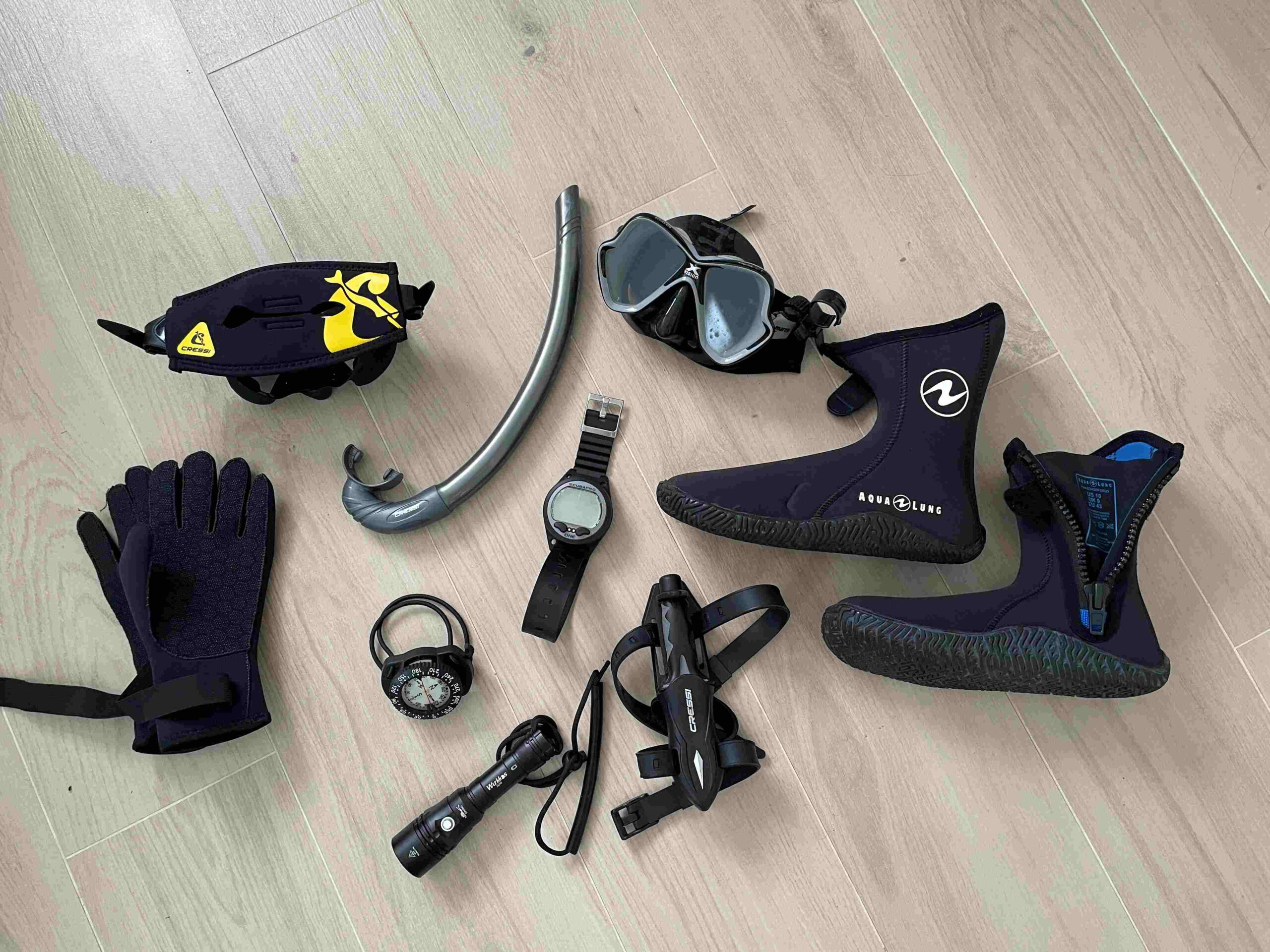
In what order would I build my first scuba kit today?
My priority would not be owning everything. I would buy the items that give me the biggest improvement in confidence, comfort, hygiene and safety first.
My beginner scuba kit, item by item
Dive computer
For me, the dive computer was the most important purchase. I wanted to become familiar with my own equipment, understand the data from each dive better and stop relying entirely on rental computers.
I use the SCUBAPRO Aladin One Matrix. I like its clear display, simple operation, backlight for night dives, Bluetooth and user-replaceable CR2450 battery.
easy to use, good readability, backlight, Bluetooth and replaceable battery.
the strap can feel a little long.
Your own dive mask
During training I tried several masks, and the Mares X-Vision Ultra LiquidSkin was the one that felt most comfortable. The material is soft, flexible and lightweight, and it fits my face very well.
A mask that fits properly can make a huge difference. If it does not leak or constantly need adjusting, you can focus much more on the dive itself.
comfortable fit, soft material, low weight and good visibility.
the strap is thin, so I prefer to protect it and take care of the mask properly.
Your own dive boots
Dive boots are one of the most logical early purchases in my view. They improve hygiene and comfort, and they are useful when you have to walk from the dive centre, car or dock to the entry point.
I use the Aqualung Echozip Ergo 7 mm. After around eight shore and boat dives, the thick sole and warmth are the two things I appreciate most.
comfortable sole, warmth, practical zip and good compatibility with open-heel rental fins.
sizing is the main thing I would check carefully.
Wrist compass
A compass is one of those accessories worth owning early if you want to practise underwater navigation and become familiar with one consistent setup.
I prefer something simple, easy to carry and readable in low-light conditions.
simple, useful for navigation practice and easy to integrate into your gear.
it only becomes useful when you actually practise with it.
Marker light and dive torch
For night dives or low visibility, a marker light can make you easier for your buddy, group or guide to see.
I would not confuse it with a primary torch. If you regularly do night dives, your main light has a different job: illuminating the environment so you can actually see.
small, simple and useful as an additional safety aid.
a marker light does not replace a main dive torch.
Flexible snorkel
I like a flexible snorkel because it is lightweight, easy to store and less intrusive than some rigid models.
It is not the item that makes the biggest difference to a dive, so I would clearly buy it after the computer, mask and boots.
flexible, lightweight and easy to store.
its impact on the overall diving experience is smaller than the first three purchases.
Neoprene mask strap cover
It sounds like a minor accessory until you use one. It reduces hair pulling, makes the mask easier to put on and spreads pressure more comfortably across the back of the head.
It also protects the original mask strap and can make the mask easier to spot if the cover has a bright colour.
comfortable, inexpensive, reduces snagging and protects the strap.
not essential, but very easy to justify for the price.
Dive gloves
Gloves can be useful for thermal protection, particularly in cooler water or during night dives.
They can also help when handling ropes or equipment on a boat. The downside is that very thick gloves reduce dexterity and sensitivity.
protection, some warmth and useful when handling ropes or gear.
too much thickness can reduce dexterity.
Dive knife or cutting tool
I include it as a safety item, not as something for touching or manipulating the underwater environment.
Its purpose is specific: ropes, fishing line, nets or another entanglement where cutting may be necessary. My own knife was not bought from Amazon; the link below shows similar alternatives.
compact and useful for genuine entanglement situations.
it must be carried responsibly and used only for genuine safety needs.
Scuba trip checklist
Once you start collecting your own gear, there is also more to forget. That is why I keep a dedicated checklist for dive trips and day outings.
It covers personal gear, documents and the practical things I would check before leaving.
What I would leave until later
I would not start by buying all of the bulky equipment. Some items are expensive, take up space, require servicing or depend heavily on the way you eventually dive.
FAQ about my first scuba diving kit
Do you need to buy all your scuba gear as a beginner?
No. I have gradually bought the personal equipment I use most while continuing to rent the bulkier items.
What three items would I buy first?
If I started again: a dive computer, a mask that fits me properly and my own dive boots.
What would I buy first on a small budget?
I would start with a comfortable mask and my own boots. They are personal, easy to store and used frequently.
What gear do I still rent?
Regulator, BCD, wetsuit, fins, tank and weights.
Is it worth buying a dive computer early?
For me, yes. Using the same computer every time helps me understand its display, alerts and information much better.
What accessories would I add later?
A compass, marker light or torch, flexible snorkel, strap cover, gloves and a compact cutting tool depending on the kind of dives I start doing.
Related guides and reviews
My advice: buy in the right order, not all at once.
For me, the dive computer, mask and boots would be the first clear purchases. After that, I would add accessories depending on the kind of diving I actually start doing.
The regulator, BCD, wetsuit, fins, tank and weights can still be rented while you gain experience and work out what you genuinely need.
See how much scuba gear costs